Showing posts with label vegetable. Show all posts

Sunday, October 17, 2010

Italian 101

I had been avoiding this theme for some time now; mostly because it seems so commonplace, broad, and non-exotic.  With all of the tomatoes, eggplant, and summer squash in our garden, though, it didn't make sense to wait any longer.  In the end, it was a very tasty and fun several weeks of cooking and eating.


Recipe sources:

  1. David Downie's "Cooking the Roman way:  Authentic recipes from the home cooks and trattorias of Rome" -- my favorite book of the bunch
  2. Lidia Bastianich's "Lidia's Italy" -- good but focused on northern Italy, especially Northeast Italy
  3. Marcela Hazen's "Essentials of classic Italian cooking" -- the most comprehensive of these cookbooks; unfortunately, the recipe names do not include the Italian translation
  4. Biba Caggiano's "Trattoria cooking"
  5. Clarissa Hyman's "Cucina Siciliana"


See this album for the recipes and photos of all of the dishes made, which I will list out here also.  The (*) symbol denotes some of my favorites:

  • Primi (soups)
    • * chickpea soup with porcini
    • pasta and chickpea soup with rosemary and garlic
    • minestrone alla Toscana (minestrone in the style of Tuscany)
  • Primi (pasta)
    • * linguine with clams
    • * spaghetti alla amatriciana
    • * pennette with cauliflower ragu
    • pasta with eggplant, tomato and red chili
    • spaghetti cacio e pepe (spaghetti with pepper and cheese)
    • pennette with summer squash (zucchini, etc.) and ricotta
    • * penne with cream sauce of ham (or prosciutto), peas, and peppers
    • fresh tagliattelle with sauce of tomato and porcini
  • Secondi (entrées)
    • chicken cacciatore (pollo alla cacciatora)
    • * coda alla vaccinara (Roman oxtail stew)
    • braised pork chops with tomatoes, cream and porcini
  • Contorni (vegetables and sides)
    • * skillet fennel with capers
    • broccoletti strascinati (boiled-sautéed broccoli rabe)
    • panfried zucchini with vinegar and herbs
    • * artichokes, Roman style (braised with garlic and mint)
    • braised Swiss chard with cannellini beans
    • gratin of artichokes
    • Signor Corsi's spicy braised cabbage
  • Miscellaneous
    • * zucchini frittata with mint
    • prosciutto with melon

General Principles:
  • Primi (pasta)
    • In general, stop cooking the pasta 1 minute before it reaches perfect "al dente" and finish cooking it once it has been tossed in with the sauce
    • use at least 5 quarts of water to cook a standard 1 pound of dry pasta
    • binders and lubricators for sauces:  diced or crushed tomato, olive oil, butter, animal fat (rendered from pancetta, etc.) cream, ricotta cheese, puréed vegetable ( e.g., roasted red pepper), pasta water, cheese ( especially Parmesan and pecorino Romano)
    • cheeses should be stirred in at the very end, after pasta has been tossed with the sauce
    • almost always serve grated cheese on the side
    • fresh pasta is more common toward the north of Italy and dried more common toward the south
    • Romans seem to be most fond of spaghetti and linguine and other long strands
  • Contorni (vegetables and sides)
    • Italians, especially towards Rome, love:  artichokes, fennel, broccoli (and broccoli rabe), and zucchini
    • Perhaps the most common way of cooking vegetables like these is to braise or pan fry them in generous amounts of olive oil, possibly some vinegar or wine, some herbs like parsley or mint, some aromatics like garlic and onion, and maybe some red pepper

Some technical notes:
    • Primi (pasta)
      • linguine with clams
        • used about 1.5 pounds of clams, which worked out well for 3 servings
        • sauce needs salt despite no mention in the recipe
        • reduced the pasta amount by 50% and the proportions seemed very nice
        • didn't filter the clam juice (contrary to the recipe) and it seemed to be fine; was careful to pre-scrub the clamshells and change the soaking water several times
        • was unable to perceive any hotness from the fresh chili pepper that I used (add more next time?)
        • The basil is a fantastic touch
      • spaghetti alla amatriciana
        • fantastic; not nearly as greasy as I feared
        • almost a "sweet" flavor from the guanchiale
      • pennette with cauliflower ragu
        • the kick from the red chili is important; don't skimp on it
        • don't worry too much about cooking each of the cauliflower pieces to uniform doneness because it is nice when the sauce has some larger chunks amongst the small pieces that turn into a pulp
      • pasta with eggplant, tomato and red chili
        • the eggplant got overly soft during the frying process; in the sauce it almost had the same texture as the tomato -- not a good thing in my opinion
      • spaghetti cacio e pepe (spaghetti with pepper and cheese)
        • accidentally used a large amount of Parmesan instead of pecorino, which really doesn't have the strength of flavor needed for this simple dish
        • the cheese ended up clumping terribly in the bowl and on the spoon
        • would it be good to add back the pasta water after adding the cheese into the noodles?
      • pennette with summer squash (zucchini, etc.) and ricotta
        • used the cheaper of the 2 brands of ricotta cheese from Bianchini's ( with the built-in strainer in the tub); had to add much more water than specified (4 or 5 tablespoons)
        • sauce needed salt-and-pepper despite no mention in the recipe
        • used 50-50 mix of zucchini and pattypan, which worked well
      • penne with cream sauce of ham (or prosciutto), peas, and peppers
        • used 50-50 mix of peeled, chopped, sautéed red peppers and Trader Joe's jarred roasted, peeled peppers; the jarred ones seem to work well
        • reduced the fat by roughly 1/3; was still sufficiently rich and good texture
      • fresh tagliattelle with sauce of tomato and porcini
        • used 50-50 mix of durum semolina and all-purpose flour
        • used 2 eggs and 1 1/3 cup flour
        • 2nd thinnest setting on pasta roller seemed best
    • Secondi (entrées)
      • chicken cacciatore (pollo alla cacciatora)
        • I made the mistake of only Browning to a "brown" color instead of to a rich brown
        • I used the expensive "Mary's pastured chicken" from Bianchini's market, which is supposedly truly free range 
        • the meat was really not tender at all; I may have erred on the side of too short of cooking time.  Is the dark meat on the drumsticks supposed to be starting to fall off the bone?
      • coda alla vaccinara (Roman oxtail stew)
        • clove aroma in the sauce is fantastic
        • the minced vegetables in the gravey are nice change of pace from the standard diced vegetables; it gives a more refined feel
      • braised pork chops with tomatoes, cream and porcini
        • used 1 inch chops instead of three-quarter inch chops
        • cooked for about 45 minutes total
        • the meat turned out tough and dry
          • because the pan was fully covered instead of slightly ajar?
          • Because I didn't flip the chops periodically?
        • in any event, the sauce was fantastic
    • Contorni (vegetables and sides)
      • braised Swiss chard with cannellini beans
        • be careful not to over cook the beans at all, otherwise they will partially disintegrate during the mixin with the other ingredients
      • Signor Corsi's spicy braised cabbage
        • adding some julienned carrots and sliced onion was a nice addition

    Sunday, August 15, 2010

    Short theme: vegetable purées

    Over the past two weeks I did some experimentation with vegetable purées.

    General principles:
    • Texture transformation:  especially in the case of the cauliflower and beets, the resulting texture is magically different -- almost unrecognizable.
    • versatility:  a single purée can often be used in several of the following ways:  soup, flavoring base for pilaf-style starch (quinoa, couscous, bulgar wheat, etc.), pasta sauce, crostini spread, sauce over meat, stand-alone side dish, flavoring in salad dressing.
    • fat/oil substitute:  the purée can often eliminate or reduce the need for added cream, butter, etc. in a pasta sauce or soup.


    Cauliflower purée
    My concoction was based closely off of this recipe.  Being without sour cream, I added 1 tablespoon of yogurt and increased the butter from 1 to 2 tablespoons and added a pinch of sugar to compensate for the sourness of the yogurt.  The result  had a nice mild flavor, yet distinctly of cauliflower.  In my opinion, the texture was not too different from nice creamy grits.  My housemate Mike was certain that it was or had potato  in it.  Next time it might be good to try it with red meat or roasted salmon.

    cauliflower purée with baby potatoes and smoked salmon


    Red beet purée
    Tried to follow this recipe.  In the end, my mix was the following (approximately):
    • 1 pound cooked beets, peeled
    • one clove garlic
    • dash cayenne pepper
    • stems of one half bunch of coriander (about 2 tablespoons chopped)
    • 12-15 leaves of mint
    • 1/4 teaspoon each of cumin and coriander
    • 1 tablespoon balsamic vinegar
    • 1 tablespoon extra virgin olive oil
    • 3 tablespoons yogurt
    • Salt ( roughly 1/4 teaspoon)
    The mint was very, very subtle; add more next time.  Additionally, the spice level could be boosted a bit.  Overall, the spread was excellent.  Mike gave it high marks and Michelle said it greatly exceeded her expectations.

    Beet purée on crostini


    Roasted red Bell Pepper purée
    I made the base sauce following this basic procedure, and reduced the oil from about 1/2 cup to 3/8 of a cup.  The basic purée had a slightly "foamy" or frothy texture -- very light in density.  I did a couple of things with this pepper sauce.  First, I made a drizzle sauce for rock cod by combining approximately 5 tablespoons of the sauce base with about 2 mL of  basalmic vinegar.  I realized that lemon juice on the fish does not combine well with the bitterness of the roasted pepper.  Also, it's imperative that the sauce and fish be served very hot.  Otherwise, I thought it worked well.   Secondly, I used about 2 tablespoons of the sauce as a flavor base for quinoa.  Finally, I mixed it with a bit of lemon juice and water to make a salad dressing, which worked out decently.
    Roasted red pepper sauce over pan-fried rock cod and cilantro


    Sweet pea custard/timbale
    The recipe comes from "The modern vegetarian" by Maria Elia.   See the recipe in the image below.  I reduced the cream by about  30%.  The texture of the custard was nice and delicate, much like a soufflé.  The little pieces of pea were definitely distinguishable since I used a food processor instead of a blender.  The egg flavor was prominent alongside the pea and mint.  We discovered that it is definitely better served warm than chilled.

    Sweet pea custard

    Recipe for Sweet pea custard
    Summer squash sauce
    This was my one true improvisational work amongst these 5 vegetable purées.  I couldn't find many recipes out there for sauces of summer squash.  There are many that use butternut squash or other winter squashes; for example, this one.  The general template seems to be: the squash, olive oil, aromatics, spice (e.g., nutmeg), herbs and cheese or cream.  With a base sauce of zucchini and patty gold squash, I made a portobello mushroom dish and two different pasta dishes.  Ingredients for the basic sauce were:
    • one large zucchini
    • An equal mass of patty gold squash
    • About one cup of chicken broth
    • one medium onion
    • one garlic clove
    • 1 tablespoon  olive oil
    • 1 tablespoon thyme leaves
    • ~25 basil leaves, coarsely chopped
    • dash of nutmeg
    • 4 teaspoons cream
    • 1 teaspoon lemon juice, or to taste

    Portobello mushroom with squash sauce

    Fusilli with bacon, mushroom, black-eyed peas and squash sauce
    The portobello dish did not work well with the sauce -- it just had too strong of a flavor for the mild squash, and the texture was not a very good match either.  The first fusilli pasta had the additional ingredients of bacon, portobello mushroom, and black-eyed peas.  I thought it worked well with the possible exception of the black-eyed peas, which have a strong flavor as far as beans go.

    The second pasta dish had shrimp seasoned with a little Hungarian paprika, julienned red bell pepper, and garlic added to the base squash sauce.  This turned out to be my favorite of the three summer squash sauce  dishes I made.
    Fusilli with shrimp and red pepper


    Posted by Picasa

    Monday, July 12, 2010

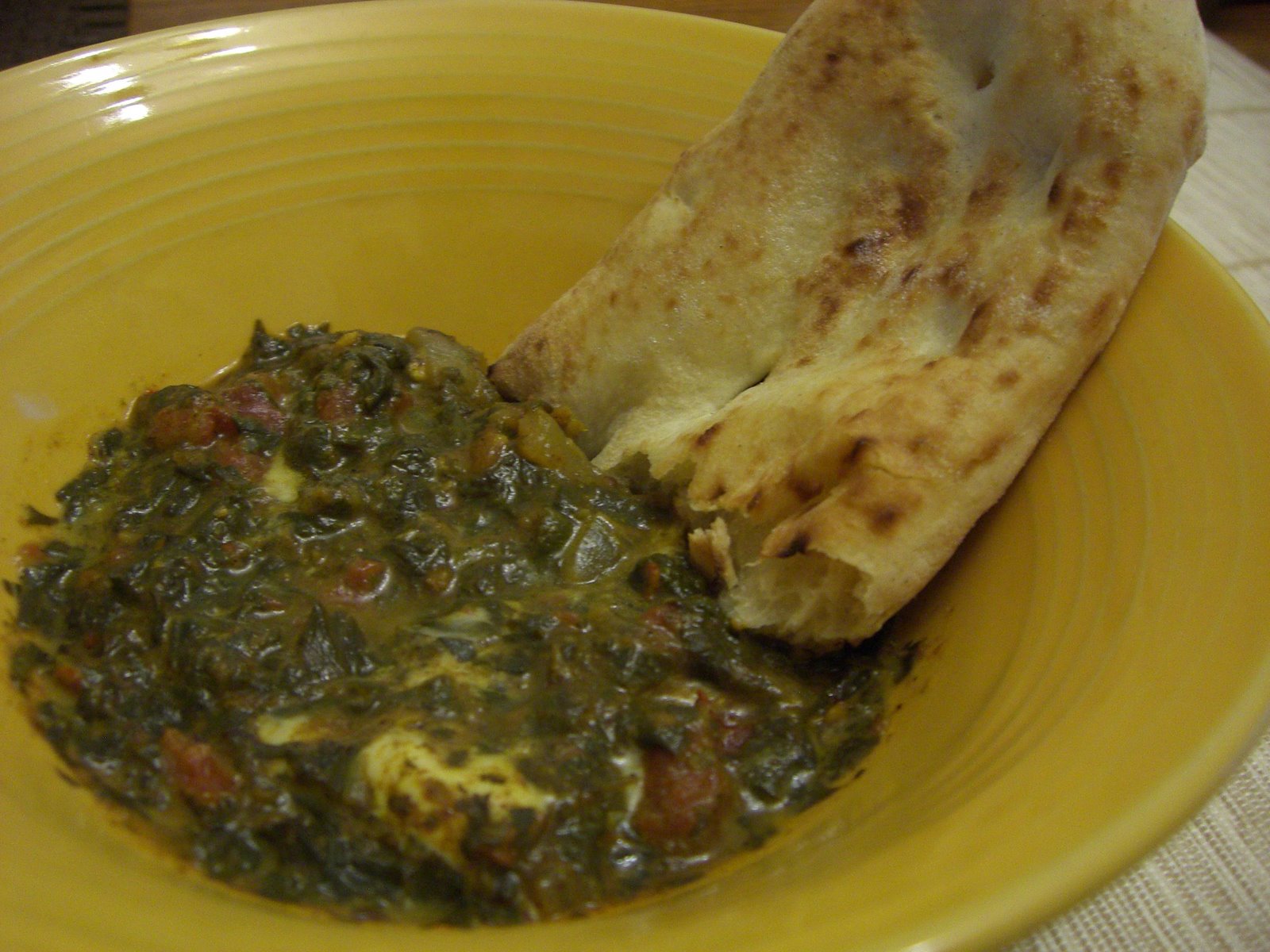
    Palak Paneer


    Recipe (from Shveta at Trovix):

    Ingredients:

    • Spinach : Half a bag of costco (I used roughly 8-10 ounces)
    • Red Onions: 1 big onion sliced thin. Regular onions would do too.
    • Tomatoes, 2 fresh (I used a 14oz can of diced tomatoes, which was too much):  see "spinach prep" below
    • Grated Fresh Ginger : 2 Tablespoons
    • Grated Fresh Garlic : 3 big cloves should be good.
    • Green Chillies: 2-3 (Note: instead of the raw ginger-garlic-chili combo, I used a heaping teaspoon of my red masala, which contains all 3)
    • Fresh Coriander/Cilantro:4-5 strands
    • Fresh Mint leaves: 8-9 leaves (I used closer to 20-25 leaves and it worked well)
    • Dried crushed Fenugreek (also called Kasuri Methi):1 teaspoon (optional)
    • Paneer ( I tried using Mexican queso fresco that I had on hand, but it proved overly crumbly)
    Prepwork for Spinach:
    1. .Put the spinach in water. Let it boil(You would know as the leaves become soft) in an open pan for 10-15 minutes. (Meanwhile You can do the prep work for tomatoes and ginger-garlic-chilli paste.)
    2. Once the spinach looks suitably boiled, take the pan,drain the hot water thru the strainer and pour cold tap water.(To make it cooler faster,you can let the spinach remain in cold water filled pan for sometime).
    3. Once done, strain it using the strainer and put it in the mixer-grinder
    4. Add the Mint leaves, Fresh cilantro and the Dried fenugreek
    5. Make a coarse paste out of it (I simply chopped it finely with knife on cutting board; would have been better if it was even finer)
    Spices:
    • Cumin seeds:1 teaspoon
    • Salt: According to your taste
    • Red chilli powder:1 tbsp (I left this out because I used my red masala paste)
    • coriander powder: 2 Tbsp
    • Turmeric: 1/3 tbsp.
    • Chaat masala: 1 tbsp/Tbsp (gives a lil sour taste) (I haven't got my hands on this spice yet)
    • Garam Masala: 1 tbsp

    How to:
    1.  Take a pan, preferably non stick.
    2.  Add 4 tablespoons cooking oil(Corn/sunflower/olive)    whatever you have at home. Keep it on Medium
    3. Add some Cumin seeds when you think oil has slightly    heated up.
    4. Add the grated ginger-garlic-Green chilli paste( You can grate them all together) to the pan.
    5.  Saute till the paste becomes light pink.
    6. Add the onions (sliced up and long).let them go a lil brown. Keep stirring so they won't stick to the pan.
    7. Add the spices (Redchilli-coriander-turmeric) to the pan.
    8. You can sprinkle lil water(2-3 tablespoons) to make sure the spices don't burn too much.
    9. Let them cook for 2 minutes. Add the Boiled tomatoes puree. cover it with a lid and let it cook for 5-7 minutes. Keep Stirring.
    10. Once you think the gravy looks suitably cooked( you will know if the color changes or let it cook as in Step 9.), Add the spinach mix paste.
    11. Mix it all well. Now let it cook for 10-15 minutes. keep the gas on Medium.
    12. Add grated cottage cheese(2x1x1 slab) or more if you like.
    13. 13.Add the chaat masala and Garam Masala. Check for salt now.
    14. Cover it with a lid for few minutes.

    Review:
    • Very tasty overall.
    • Queso fresco does not work as a substitute for paneer. :)
    • Maybe a little too much tomato? Might be better if the tomato was more finely chopped or puréed.


    Posted by Picasa

    Saturday, July 10, 2010

    Indian-spiced roast cauliflower

    From Jamie Oliver's: "Cook with Jamie".

    This is a really unique way to serve cauliflower, at least in the US. I think I may have slightly overcooked the spices in the oil in the first up, but it still turned out really tasty. Here's the ingredient list:
    • one head of cauliflower florets
    • Sea salt
    • olive oil
    • butter
    • cumin seed, whole
    • coriander seed, whole
    • dried chili
    • almonds blanched, smashed (I believe I used roasted almonds, instead; how does blanching taste different?)
    • lemon zest and juice
    d


    Posted by Picasa

    Saturday, May 1, 2010

    Celeriac with Turmeric

    From "The new book of Middle Eastern food". It doesn't specify a country/ethnicity of origin, but I will guess Eastern or Southern Mediterranean because of the turmeric.

    Although simple, the dish was like nothing I've had before (the fact that I've almost never had celeriac helps that cause). The celeriac cubes take on a light yellow color, which makes them almost look like pineapple chunks.

    The one issue I had was trying to reduce the broth to a thick sauce at the end. I must have started with too much water.

    Also, some of the chunks of celeriac still had some of that very fibrous stringy tissue on them still. Next time, need to cut off more of the outer celeriac layer.


    Posted by Picasa

    Eggplant slices with pomegranate syrup

    Native name: "Betingan bel Rumman"; note: I tried to use Google translate to verify what language this is in and what the literal translation is, but had no success.  I'm assuming it's the phonetic transcription of the Arabic name of the dish (because the dish is from Syria).

    Recipe from "The new book of Middle Eastern food."

    This turned out okay; it had a major sour kick, though (from the pomegranate).  Also, I think the eggplant was undercooked:  it definitely had some from texture still and that bitter taste that raw eggplant has.  The slices that were the most cooked definitely tasted the best.  The problem is that all of the slices were beginning to significantly brown when I took them out of the broiler, so they couldn't have gone much longer.  The broiler was on "high" and the surface of the pan was 4.5 inches below the gas opening.  Next time, either cut them thinner, or use a lower temperature broiler setting (or bake).  I was somewhat stingy with the brushed-on olive oil also.  I wonder if more liberal oil application would help distribute the heat?


    Posted by Picasa

    Sunday, April 25, 2010

    Adzharian-style green beans with cinnamon-flavored yogurt sauce

    A Georgian dish from Paula Wolfert's "The cooking of the Eastern Mediterranean". I'm not sure if I would recognize this as Mediterranean/Middle Eastern, but hey, it has plenty of yogurt, right?

    I made the mistake of bringing the heat too high after adding the yogurt, which caused it to curdle slightly (note the chunky appearance in the photo). Also, I felt the yogurt had a very rich, almost cheesy, complexion, making the dish a little heavy for my palate. Housemate Mike loved it, though.


    Posted by Picasa

    Saturday, April 10, 2010

    Okra braised with tomatoes and onions


    This recipe also comes from "The cooking of the eastern Mediterranean".

    This was my first experience cooking with okra and I think it turned out well. By simmering the vegetables covered with parchment paper and a tightly closed lid, we help ensure that the vegetables don't get overcooked or dried out.

    I must say that the presentation of the final dish was fantastic! With the perfectly arranged hub and spoke pattern of the okra nestled on top of the tomatoes, onion mixture.


    Posted by Picasa

    Spinach pâté

    The recipe comes from Paula Wolfert's "The cooking of the eastern Mediterranean"; I believe the dish is Georgian in origin.

    It reminds me a lot of an Italian pesto, except that the basil is replaced by spinach, the pinenuts are replaced by mashed walnuts, and vinegar is added for moisture instead of olive oil.

    Mike and I really enjoyed this as a spread on toasted bread.
    Posted by Picasa

    Eggplant steamed in tomato sauce

    This was the kickoff for the start of my "Eastern Mediterranean" cooking theme. I'm not sure if I would recognize it as Mediterranean, if it weren't for the eggplant part of it.

    As advertised, the dish has a very prominent vinegar flavor -- a taste that is somewhat foreign to me. In any event, it was easy, healthy, and kept well as leftovers.

    Posted by Picasa

    Wednesday, March 24, 2010

    Whole cauliflower with tomato and olive sauce

    From Jamie Oliver's "Cook with Jamie" (on my bookshelf), page 345.

    Given that I am a newcomer to the world of anchovies, it was difficult for me to immediately fall in love with the final dish. However, it definitely grew on me; and by day 3 of eating the leftovers, I thought it was quite tasty!

    It is a excellent mix of classic whole vegetables and unfamiliar sauciness.

    During the final seasoning process, I couldn't tell whether it was over or under salted. I think the anchovy flavor (umami) was confusing me.
    Posted by Picasa

    Tuesday, March 23, 2010

    Coleslaw -- Jamie Oliver's favorite

    The recipe comes from "Cook with Jamie", which sits on my bookshelf at home.

    The base vegetables are white cabbage, red onion, carrot, and apple. I thought it would be simple to Julianne and slice all of these vegetables in the Cuisinart, but that was not quite the case. Slicing is straightforward, but julianning is a pain in the ass because you have to slice first, then gather up the slices from the Cuisinart bowl and reinsert them into the feed tube in the "opposite" orientation. Clearly, I need to get myself a mandoline.

    Since I was short on lemon juice for the dressing, I ended up using some oranges, squeezed from our garden as well as some apple cider vinegar (it's all fruity right?).

    I think the final result was quite good. The crowd at Chu's pulled pork/chicken basketball-viewing party gave excellent reviews for the coleslaw -- especially the lightness of the dressing and the sweetness of the apple.
    Posted by Picasa